Agent-to-Agent Commerce: When Your Brand Agent Meets a Customer's Shopping Agent
AI shopping agents from ChatGPT, Gemini, and Perplexity will soon negotiate directly with brand agents deployed by merchants. Here's how A2A commerce works and what DTC brands need to do now.
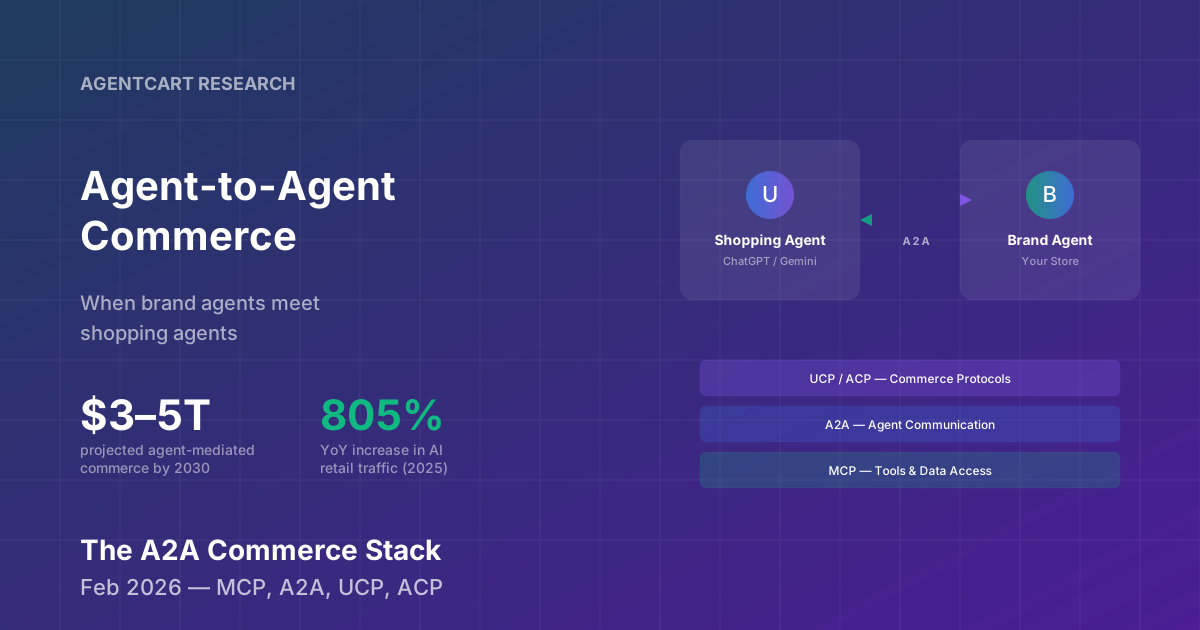
Imagine a customer tells ChatGPT: "Find me a sustainable sneaker under $150 in my size." ChatGPT's shopping agent reaches out to a dozen brand agents — Allbirds, On Running, Veja — and each brand agent responds with personalized offers, real-time inventory, and loyalty perks. The two agents negotiate, the customer picks a winner, and checkout completes without ever opening a browser tab.
This isn't science fiction. The infrastructure for agent-to-agent (A2A) commerce is being built right now, and it's moving faster than anyone expected.
The New Commerce Stack
In the past 12 months, a full protocol stack for agentic commerce has emerged. Understanding it is critical for any DTC brand that wants to stay relevant:
- MCP (Model Context Protocol) — Created by Anthropic, now governed by the Linux Foundation. MCP connects AI agents to tools and data sources — think of it as the "USB-C for AI." It lets an agent read your product catalog, check inventory, or query your CRM.
- A2A (Agent-to-Agent Protocol) — Launched by Google in April 2025 with 50+ partners, now also under the Linux Foundation with 150+ supporting organizations. A2A defines how agents discover each other, exchange messages, negotiate tasks, and report results. It's built on HTTP, SSE, and JSON-RPC 2.0.
- UCP (Universal Commerce Protocol) — Co-developed by Google and Shopify (January 2026). UCP is the commerce-specific layer that defines how agents discover products, understand checkout requirements, and complete purchases. It supports REST, MCP, A2A, and payment protocol connections.
- ACP (Agentic Commerce Protocol) — Co-developed by OpenAI and Stripe (September 2025). ACP creates a shared language between merchants and AI agents, enabling instant checkout directly inside ChatGPT conversations.
The key insight: MCP connects agents to data. A2A connects agents to each other. UCP and ACP define the commerce rules. Together, they enable a world where your brand has its own AI agent that speaks directly to a customer's AI agent.
What's Already Live
This isn't theoretical. Agent-mediated commerce transactions are happening at scale today:
ChatGPT Instant Checkout
OpenAI launched in-conversation purchasing in the US. Users can browse, compare, and buy products without leaving ChatGPT. Launch partners include Etsy, Target, DoorDash, and over 1 million Shopify merchants (including Glossier, SKIMS, Spanx, and Vuori). Instacart went live in December 2025 as the first company to offer end-to-end grocery shopping inside ChatGPT, covering 1,800+ retailers.
The traffic impact is already significant: ChatGPT now drives more than 20% of referral traffic to Walmart, nearly 15% to Target, and 10% to eBay.
Google "Buy for Me"
Google launched agentic checkout across Search AI Mode and Gemini in November 2025. When a user tracks a price and sets preferences (size, color, budget), Google monitors prices. When conditions are met, the user gets a notification and Google's agent adds the item to the merchant's cart and completes checkout via Google Pay. Live with Wayfair, Chewy, Quince, and Shopify merchants.
Perplexity Shopping
Perplexity expanded its "Buy with Pro" shopping experience to all users in November 2025, powered by Firmly.ai's agentic commerce technology and integrated with PayPal/Venmo for in-app checkout. The merchant remains the merchant of record — no new engineering work required.
Payment Infrastructure
Visa launched its Trusted Agent Protocol (October 2025) to distinguish legitimate AI agents from bots — over 100 partners worldwide. Mastercard rolled out Agent Pay to all US cardholders (November 2025) using Agentic Tokens — dynamic cryptographic credentials that bring tokenization from mobile payments to agent commerce. Visa expects millions of consumers to use AI agents for purchases by the 2026 holiday season.
The Agent-to-Agent Vision
Everything above is consumer agent → merchant store — a one-sided interaction. The next wave is consumer agent ↔ brand agent — a two-sided negotiation. This is where A2A changes everything.
Here's how it works:
- Discovery — Your brand agent publishes an "Agent Card" (defined by the A2A spec) that describes its capabilities: product search, personalized recommendations, loyalty program access, return handling
- Connection — A customer's shopping agent (ChatGPT, Gemini, Perplexity) discovers your Agent Card and initiates a conversation
- Negotiation — The agents exchange messages. The shopping agent shares the customer's preferences and constraints. Your brand agent responds with tailored offers — maybe a bundle deal, a loyalty discount, or a recommendation based on past purchases
- Transaction — The agents agree on terms. Payment flows through ACP/UCP with Visa or Mastercard token verification. The customer confirms with a single tap
- Post-sale — Your brand agent handles order updates, shipping notifications, and returns — all through the A2A channel, without the customer needing to visit your site
This is a fundamental shift. Today, brands compete for visibility on a Google results page or a ChatGPT shopping carousel. Tomorrow, brands compete by having the best agent — the one that gives the most relevant response, the fastest, with the best offer.
What the Platforms Are Building
Shopify
Shopify is arguably the furthest along. Their Winter '26 Edition introduced three key pieces:
- Brand Agents — A turnkey solution for merchants to deploy an AI agent trained on their product catalog. It answers product questions, engages shoppers in natural brand-aligned conversations, and is ready to deploy with minimal setup
- Agentic Storefronts — Surfaces your products on AI platforms like ChatGPT, Perplexity, and Microsoft Copilot. Shopify Catalog syndicates products to AI chats without bespoke integrations
- UCP — Co-developed with Google, UCP is the open standard connecting agents to commerce. It supports discount codes, loyalty credentials, subscription billing, and selling terms in AI chat
Shopify also released a Dev MCP Server and a Dev Dashboard for building agentic commerce experiences — 150+ product updates in the Winter '26 Edition alone.
Salesforce Commerce Cloud
Salesforce launched Agentforce Commerce with four capabilities: Guided Shopping (conversational commerce), Order Routing (autonomous fulfillment), Merchandising Actions (catalog management via natural language), and Point-of-Sale Actions. They also adopted the Agentic Commerce Protocol in partnership with Stripe. AI assistant-driven traffic grew 119% year-over-year in H1 2025.
BigCommerce
BigCommerce partnered with Stripe's Agentic Commerce Suite to enable merchants to sell through AI agents. Their API-first architecture makes integration straightforward — AI agents can autonomously adjust product placement, pricing, and promotions based on real-time behavior and inventory.
WooCommerce
WooCommerce released an MCP server in developer preview, acting as a security proxy that translates protocol requests into WordPress actions. Multiple ACP plugins have already emerged (AgenticCart, Ovena ACP, ACPWoo), and UCP implementation guides are available. For the ~40% of e-commerce sites running on WordPress, this opens the door to agent commerce without a platform migration.
What This Means for DTC Brands
McKinsey projects that AI agents could mediate $3 trillion to $5 trillion of global consumer commerce by 2030. Morgan Stanley predicts nearly half of online shoppers will use AI shopping agents by 2030, accounting for about 25% of spending. The brands preparing now will capture a disproportionate share.
Here's the strategic question every DTC brand should be asking: when a customer's AI agent asks "find me a sustainable sneaker under $150," will your brand be discoverable, trustworthy, and transactable in that agent-mediated environment?
The answer depends on three layers of readiness:
Layer 1: Be Discoverable (Do This Now)
- Implement complete Schema.org Product markup with GTINs, ratings, multiple images, and accurate pricing
- Ensure your product feeds are current and complete for Google Shopping and ChatGPT
- Allow AI crawlers in your robots.txt (PerplexityBot, ChatGPT-User, Googlebot)
- Create a UCP manifest at
/.well-known/ucp.json— even a basic one puts you ahead of 95% of merchants
Layer 2: Be Transactable (Next 6 Months)
- Adopt ACP to enable instant checkout inside ChatGPT and other AI agents
- Implement UCP checkout endpoints so Google's agent can complete purchases natively
- Integrate with Visa Trusted Agent Protocol or Mastercard Agent Pay for secure agent-initiated payments
- If on Shopify, enable Agentic Storefronts and Shopify Catalog syndication
Layer 3: Deploy Your Brand Agent (Next 12 Months)
- Deploy a brand agent (via Shopify Brand Agents, custom build, or third-party) that represents your brand in A2A conversations
- Publish an A2A Agent Card declaring your agent's capabilities
- Train your agent on your product catalog, brand voice, return policies, and loyalty program
- Enable personalized negotiation — your agent should offer different deals to different customer profiles based on purchase history and lifetime value
The Competitive Advantage
Here's what makes this moment so critical: the infrastructure is standardizing under open protocols. In December 2025, the Linux Foundation established the Agentic AI Foundation — co-founded by Anthropic, Block, Google, Microsoft, and OpenAI — focused on interoperability, identity, and payments for autonomous commerce.
This means the brands that adopt these protocols early won't be locked into a single platform. An A2A-ready brand agent works with ChatGPT, Gemini, Perplexity, and whatever comes next. The investment compounds.
Conversely, brands that wait will find themselves invisible to an increasingly large share of shopping traffic that never touches a traditional search results page or product listing.
Adobe reported that AI traffic to US retail sites increased 805% year-over-year on Black Friday 2025. That number is only going up.
Start With Your Score
Before you can build a brand agent, you need to get the foundation right. Most brands we audit still score below 50 on basic AI readiness — missing GTINs, incomplete Schema.org markup, no UCP manifest.
Run an AgentCart audit to see where your store stands today — and get a clear roadmap for each layer of agent commerce readiness.
Check your AI commerce readiness
Get your free score across Google UCP, ChatGPT Shopping, and Schema.org in under 30 seconds.
Run a free scan