L'Oréal Paris Scores 41/100 on AI Shopping Readiness — Here's What That Means
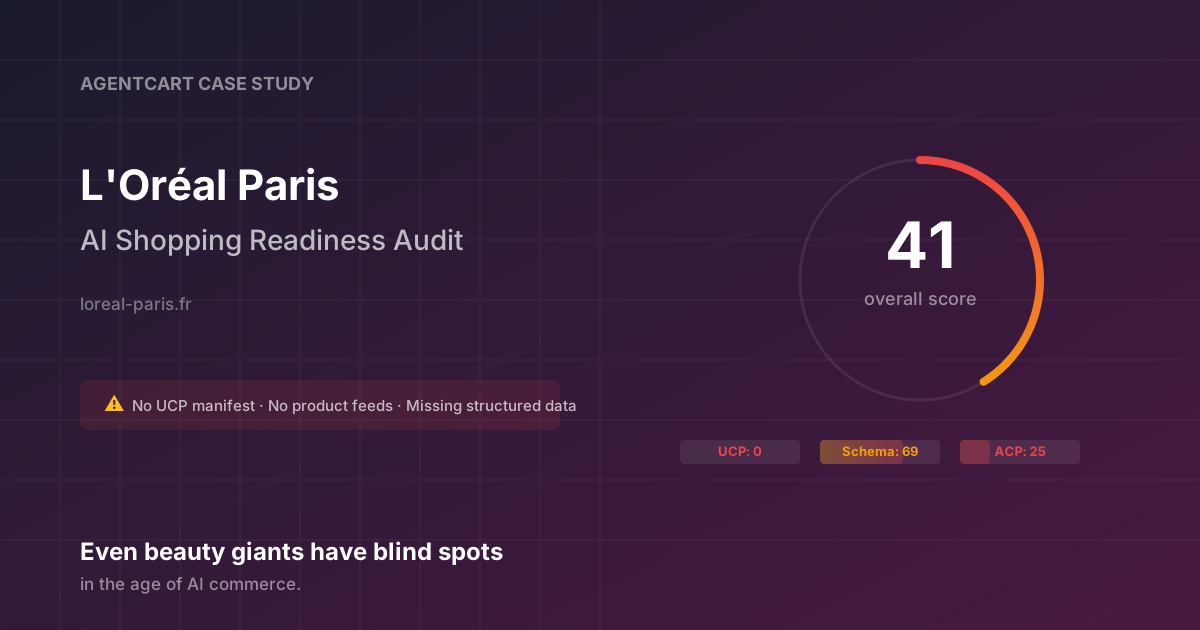
We audited loreal-paris.fr across Google UCP, Schema.org, and ChatGPT Shopping. The world's largest beauty brand scored 0 on UCP, 69 on Schema, and 25 on ACP. A breakdown of what's missing and why it matters.
L'Oréal is the world's largest cosmetics company. With over €41 billion in annual revenue, a portfolio spanning 36 brands, and e-commerce representing more than a quarter of total sales, you'd expect their digital infrastructure to be ahead of the curve.
We ran loreal-paris.fr — the flagship DTC site for L'Oréal Paris in France — through AgentCart's AI Shopping Readiness audit. The results were surprising.
The Scores
| Platform | Score | Verdict |
|---|---|---|
| Google UCP | 0 / 100 | No manifest found |
| Schema.org | 69 / 100 | Partial — homepage accessible, but gaps |
| ChatGPT Shopping (ACP) | 25 / 100 | Critical data missing |
| Overall | 41 / 100 |
An overall score of 41 puts L'Oréal Paris well below the threshold where AI shopping agents can reliably discover, understand, and recommend their products. Let's break down each platform.
Google UCP: 0/100 — Completely Absent
Google's Universal Commerce Protocol (UCP), co-developed with Shopify in January 2026, is how Google's AI Mode and Gemini Shopping discover merchant capabilities. The protocol requires a JSON manifest at /.well-known/ucp.
L'Oréal Paris returned HTTP 404 at this endpoint. Every check failed:
- UCP Manifest — Not found
- Shopping Service — Cannot check
- Transport Binding — Cannot check
- Checkout Capability — Cannot check
- Payment Handlers — Cannot check
- Fulfillment Capability — Cannot check
- Discount Extension — Cannot check
Without a UCP manifest, L'Oréal Paris is completely invisible to Google's AI shopping agents. When a user asks Gemini "find me a moisturizer under €30," L'Oréal won't even be in the candidate set. Google's agent literally has no way to discover what L'Oréal sells, how to check out, or what payment methods they accept.
Why this matters
UCP is the commerce layer that powers Google's "Buy for Me" feature, now live in Search AI Mode. Brands like Wayfair and Chewy have already implemented it. As agentic checkout expands to beauty and personal care, brands without UCP will lose transactions to competitors who have it — even if those competitors are smaller or less well-known.
Schema.org: 69/100 — The Foundation Exists, Barely
Schema.org structured data is the language AI agents use to understand what's on a page. It's the most established protocol and powers not just Google, but also Perplexity, Bing Copilot, and other AI surfaces.
Here's what we found:
- Website Accessible — Pass. The homepage loads correctly.
- Homepage Schema — Warning. No
OrganizationorWebSiteschema found on the homepage. AI agents can't confirm they've reached the right brand. - Product Pages Found — Warning. Our crawler could not find product page links from the homepage.
The 69 score is generous — it reflects the site being accessible and likely having some schema on deeper pages. But the homepage, the front door for AI agents, provides no structured data about the brand, the catalog, or how to navigate to products.
Why this matters
When Perplexity Shopping tries to answer "best L'Oréal moisturizer for dry skin," it looks for Organization schema to verify the brand, Product schema to understand the catalog, and AggregateRating to rank options. Without homepage schema pointing to product pages, L'Oréal's own DTC site loses to third-party retailers (Amazon, Sephora, Ulta) that do have clean structured data.
ChatGPT Shopping (ACP): 25/100 — Critical Gaps
OpenAI's Agentic Commerce Protocol (ACP) powers ChatGPT's in-conversation shopping. To surface products, ChatGPT relies on product feeds enriched with structured data from the merchant's site. Here's where L'Oréal Paris stands:
| Check | Status | Detail |
|---|---|---|
| Product Title | Pass | Title available for feed |
| Product Description | Fail | Missing or too short for ChatGPT |
| Price Data | Fail | No price data found |
| Availability Status | Warning | No in_stock / out_of_stock signal |
| GTIN/MPN | Fail | No product identifiers |
| Star Ratings | Fail | No rating data |
| Product Category | Warning | No category taxonomy |
| Q&A Content | Warning | No FAQ content |
| Product Image | Fail | No product image found |
| Open Graph Tags | Fail | Missing og:title, og:description, og:image, og:url |
| Brand Info | Warning | No brand metadata |
Out of 11 checks, only 1 passed. Six failed outright, four returned warnings. The only thing ChatGPT can pick up is the product title. There's no price, no image, no GTIN, no description, and no OG tags.
The noindex problem
A telling detail from the raw data: the site's meta tags include robots: noindex,nofollow. This is likely a regional or consent-related configuration, but it signals to crawlers — including AI agents — that the page should not be indexed. For AI commerce, this is a significant barrier. Even if product data existed, agents would be told not to use it.
Why this matters
ChatGPT Shopping is already driving 20%+ of referral traffic to major retailers. When a user asks ChatGPT "recommend a good anti-aging serum," it builds its answer from product feeds and on-page data. Without descriptions, prices, images, and GTINs, L'Oréal products can't appear in these conversations — or worse, they appear with incomplete information that drives users to competitors.
The Bigger Picture: Brand vs. Retailer
The irony is that L'Oréal products are almost certainly being recommended by AI agents — just not via loreal-paris.fr. Amazon, Sephora, and Ulta have extensive structured data for L'Oréal products. When ChatGPT recommends "L'Oréal Revitalift," it links to a retailer, not to L'Oréal's own site.
This is the core tension for DTC brands in AI commerce: if your own site isn't AI-ready, you lose the direct relationship. The customer discovers your product through AI, but the transaction and the data go to a third party.
For a company that has invested heavily in DTC e-commerce, this represents a meaningful gap in their digital strategy.
What L'Oréal Paris Should Do
The fixes are well-defined and achievable:
- Deploy a UCP manifest — Host a JSON file at
/.well-known/ucpdeclaring shopping services, transport bindings, checkout capabilities, and payment methods. This unlocks Google AI Mode and Gemini Shopping. - Add Organization and WebSite schema to the homepage — This helps AI agents verify they've reached the official L'Oréal Paris site and discover the product catalog.
- Enrich product pages with full JSON-LD — Include Product schema with name, description, image, offers (price, currency, availability), brand, GTIN, and aggregateRating.
- Implement Open Graph tags — Add og:title, og:description, og:image, and og:url to every product page. These are the fallback data source for ChatGPT's product feeds.
- Review the noindex directive — If the
noindex,nofollowis intentional (consent/geo), consider allowing AI agent crawlers specifically. If it's a misconfiguration, fix it immediately. - Add GTIN/EAN codes to product markup — L'Oréal products have EAN codes. Embedding them in structured data enables ChatGPT's product matching, which heavily relies on these identifiers.
The Takeaway
L'Oréal Paris scoring 41/100 isn't a failure of technology — it's a gap in awareness. The protocols powering AI commerce (UCP, ACP, enhanced Schema.org) are new, fast-moving, and not yet on most brands' radar. But adoption is accelerating. Shopify merchants get UCP for free. Amazon and Sephora already have deep AI-readable product data.
The window for large DTC brands to own their AI commerce presence is open now, but it won't stay open forever. Every week without a UCP manifest or enriched product schema is a week where AI agents route L'Oréal's own customers to third-party retailers.
If the world's largest beauty company has blind spots in AI readiness, chances are your brand does too.
Check your AI commerce readiness
Get your free score across Google UCP, ChatGPT Shopping, and Schema.org in under 30 seconds.
Run a free scan