What Is Google UCP? The Merchant's Complete Guide
Google's Universal Commerce Protocol lets AI agents browse, compare, and buy from your store. Here's how it works and how to implement it.
In late 2024, Google quietly launched one of the most important e-commerce protocols in years: the Universal Commerce Protocol (UCP). It's the backbone of how Google AI Mode, Gemini, and future Google agents will interact with online stores.
If you run an e-commerce store, you need to understand UCP. Here's everything you need to know.
What Is UCP?
UCP is a standardized protocol that allows AI agents to programmatically interact with e-commerce sites. Think of it as an API layer between AI shopping assistants and your store. Instead of scraping your website or relying solely on product feeds, AI agents can use UCP to:
- Discover products — Search your catalog with natural language queries
- Get real-time data — Check availability, pricing, and shipping options
- Manage carts — Add items, apply coupons, calculate totals
- Complete checkout — Process purchases on behalf of users
- Handle returns — Initiate returns and track refund status
How UCP Works
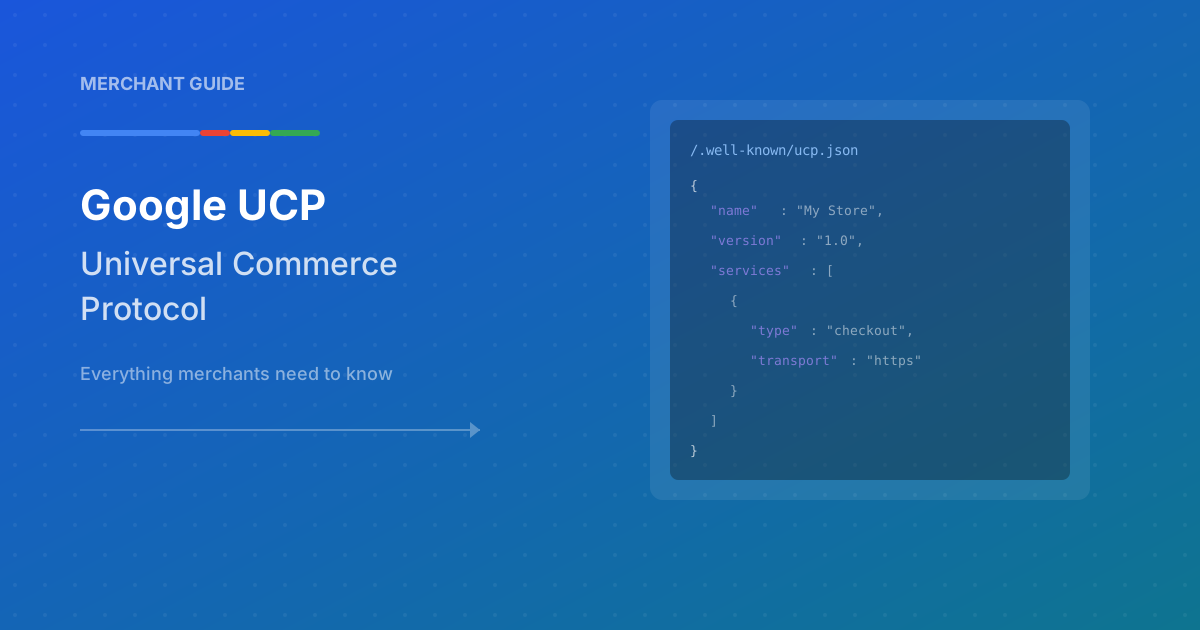
At its core, UCP is a JSON manifest hosted at /.well-known/ucp.json on your domain. This manifest declares what services your store supports and how AI agents should interact with them.
A basic UCP manifest looks like this:
{
  "name": "My Store",
  "version": "1.0",
  "description": "Official UCP endpoint for My Store",
  "services": [
    {
      "type": "product_search",
      "endpoint": "/api/ucp/search",
      "transport": "https",
      "auth": "api_key"
    },
    {
      "type": "checkout",
      "endpoint": "/api/ucp/checkout",
      "transport": "https",
      "auth": "oauth2"
    }
  ]
}
When a Google AI agent needs to help a user find or buy a product, it checks for this manifest first. If it exists, the agent knows exactly how to interact with your store — no scraping needed.
Why UCP Matters Now
Google AI Mode is already live in Search. When users ask shopping-related questions, Google's AI can surface products, compare prices, and even start checkout flows. Currently, this relies on Google Shopping feeds and structured data. But UCP is how it will work natively.
Here's why early adoption matters:
- First-mover advantage — Almost no merchants have implemented UCP yet. Being early means more visibility when Google ramps up AI shopping.
- Better data, better recommendations — UCP gives AI agents real-time access to your catalog, versus stale feed data that might be hours or days old.
- Higher conversion — AI-initiated checkouts have fewer friction points than redirecting users to your website.
- Future-proofing — As more AI agents adopt UCP (not just Google), your implementation works across platforms.
What AgentCart Checks
When we scan your site for UCP readiness, we check:
- Manifest presence — Does
/.well-known/ucp.jsonexist and return valid JSON? - Service declarations — Which services are declared (search, cart, checkout, returns)?
- Transport bindings — Are endpoints using HTTPS with proper authentication?
- Checkout capabilities — Can an AI agent actually complete a purchase through your UCP endpoints?
- Schema compliance — Does the manifest follow the UCP specification format?
How to Get Started
You don't need to implement the full UCP spec on day one. Start with the basics:
- Create the manifest file — Host a valid
ucp.jsonat/.well-known/ucp.jsonwith your store name and version - Declare product search — Add a search service endpoint that returns product data in UCP format
- Add authentication — Implement API key or OAuth2 authentication for your endpoints
- Test with AgentCart — Run a scan to verify your manifest is discoverable and valid
Even a basic manifest with just a product search endpoint puts you ahead of 95% of e-commerce sites. As Google expands AI Mode capabilities, you can incrementally add cart management and checkout.
Check your UCP readiness with a free AgentCart scan.
Check your AI commerce readiness
Get your free score across Google UCP, ChatGPT Shopping, and Schema.org in under 30 seconds.
Run a free scan