Are Shopify’s 50 Best Stores Ready for Agent Commerce?
We audited every store on Shopify’s “Best of 2026” list across four AI commerce protocols and benchmarked their visibility on ChatGPT, Gemini, and Perplexity. Most aren’t ready for the AI shopping revolution.
Shopify recently published their annual list of 50 Best Shopify Stores to Inspire Your Own (2026) — a curated showcase of beautiful, successful ecommerce stores spanning fashion, food, beauty, home goods, and more. Brands like Allbirds,
Fly By Jing,
Rothy’s, and
Made In Cookware made the cut, celebrated for their design, branding, and customer experience.
But there’s a question Shopify didn’t ask: Are these stores ready for the next wave of ecommerce — where AI agents do the shopping?
We ran every single store through AgentCart’s audit and benchmark system to find out. The results reveal a massive gap between looking good to humans and being discoverable by machines.
What Is Agent Commerce Readiness?
Agent commerce is the emerging paradigm where AI assistants — ChatGPT, Google Gemini, Perplexity, Microsoft Copilot — recommend, compare, and even purchase products on behalf of consumers. Instead of browsing a website, a shopper asks their AI: “What’s the best sustainable sneaker brand?” or “Find me an organic chocolate gift under $50.”
For this to work, stores need to be readable by AI systems across four dimensions:
- UCP (Universal Commerce Protocol) — Google’s
.well-known/ucpmanifest, a machine-readable declaration of commerce capabilities, payment methods, and fulfillment options - Schema.org Markup — Structured product data (prices, availability, reviews) that AI crawlers can parse
- ACP (Agent Commerce Protocol) — Shopping feed data accessible to AI agents like ChatGPT
- Agent Accessibility — Whether AI crawlers (ChatGPT-User, Google-Extended, PerplexityBot) are allowed to access the site
We scored each store 0–100 across these four platforms, then ran AI simulations to measure actual brand visibility — how often ChatGPT, Gemini, and Perplexity mention and recommend each brand.
The Big Picture: A 70/100 Average Hides a Deeper Problem
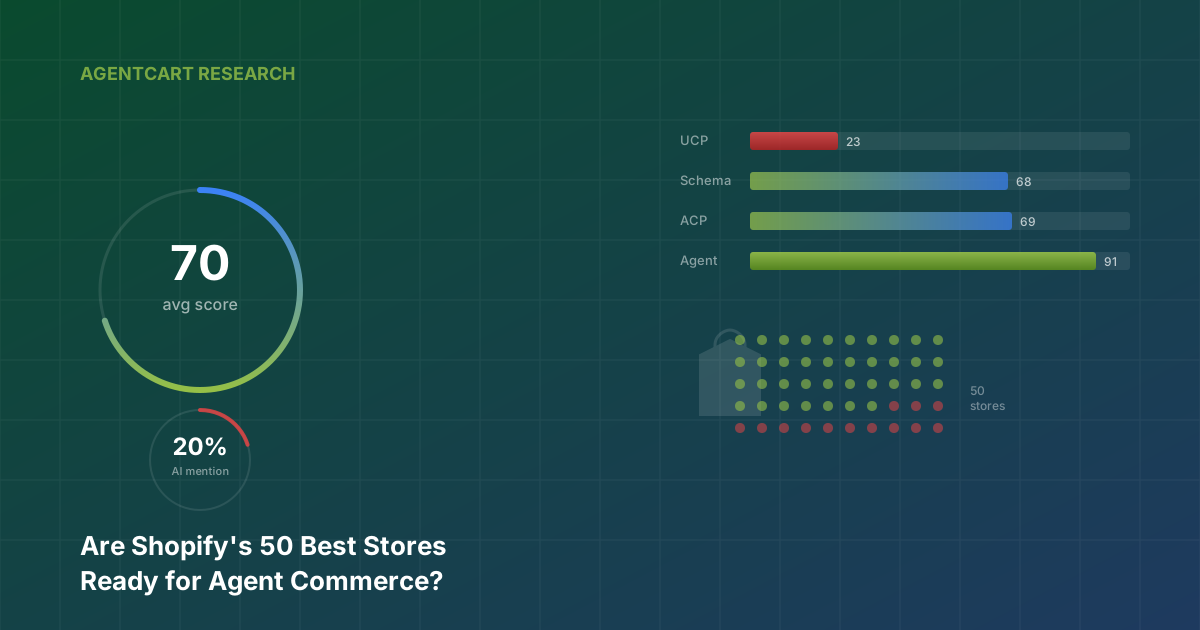
Across all 50 stores, the average readiness score was 69.7 out of 100, with a median of 77. At first glance, that looks decent.
| Readiness Level | Stores | Percentage |
|---|---|---|
| High (70+) | 37 | 69% |
| Medium (40–69) | 14 | 26% |
| Low (<40) | 3 | 6% |
But the average masks a stark reality: scores are being propped up by one platform and dragged down by another.
The Platform-by-Platform Story
| Platform | Average Score | Stores Scoring 70+ | Stores Scoring <40 |
|---|---|---|---|
| Agent Accessibility | 91.2 | 94% | 0% |
| ACP | 69.2 | 65% | 6% |
| Schema.org | 68.1 | 65% | 19% |
| UCP | 23.4 | 0% | 100% |
Agent Accessibility: The Easy Win (91.2 avg)
The good news: 94% of stores allow AI crawlers to access their sites. Most Shopify stores haven’t blocked ChatGPT-User, Google-Extended, or PerplexityBot in their robots.txt. This is the baseline — if AI agents can’t even visit your store, nothing else matters.
Schema.org Markup: The Shopify Advantage (68.1 avg)
Shopify’s platform provides built-in structured data for products, which gives stores a head start. 65% scored 70 or above on schema markup. But it’s not automatic — stores with minimal product descriptions, few product pages, or heavy customization often lose their schema data. 19% of stores scored below 40, meaning AI systems can’t reliably extract product information.
Top schema performers like LunchSkins (92),
LastObject (94), and
Beauty Bakerie (92) had rich, well-structured product catalogs. Bottom performers like
Fresh Heritage (0) and
Yeung Man Cooking (13) had virtually no parseable product data.
ACP (Agent Commerce Protocol): Split Down the Middle (69.2 avg)
ACP readiness largely tracks schema quality — if your products have structured data, AI shopping agents can build feeds from them. 65% scored well, but brands without solid schema foundations scored poorly here too.
UCP: The Massive Blind Spot (23.4 avg)
Here’s the headline: Not a single store on Shopify’s “Best 50” list has implemented Google’s Universal Commerce Protocol. Zero out of 50. Every store scored below 40 on UCP.
UCP is Google’s machine-readable commerce manifest — it tells AI agents what a store sells, how payments work, what fulfillment options exist, and what services are available. Without it, AI agents have to guess. With it, they can confidently recommend and transact.
This isn’t just a Shopify problem — UCP is still early. But it represents the single biggest opportunity for forward-thinking merchants. The first stores to implement UCP will have a structural advantage as AI-powered shopping scales.
The AI Visibility Reality Check
Readiness scores tell you if a store could be discovered by AI. But is it? We simulated real shopping queries across ChatGPT, Gemini, and Perplexity to measure actual brand visibility.
| AI Model | Avg Mention Rate | Avg Recommendation Rate |
|---|---|---|
| Gemini | 25.5% | 23.8% |
| ChatGPT | 22.4% | 19.6% |
| Perplexity | 12.8% | 11.2% |
| Overall | 20.2% | 18.2% |
On average, these top Shopify stores are mentioned in only 1 in 5 relevant AI queries. They’re recommended even less often. And Perplexity — which focuses on sourced, factual answers — mentions them least of all.
Who’s Winning the AI Visibility Game?
| Rank | Brand | Mention Rate | Recommendation Rate |
|---|---|---|---|
| 1 | 75% | 67% | |
| 2 | 67% | 67% | |
| 3 | 56% | 50% | |
| 4 | 53% | 53% | |
| 5 | 50% | 50% | |
| 6 | 44% | 42% | |
| 7 | 42% | 39% | |
| 8 | 36% | 28% | |
| 9 | 33% | 25% | |
| 10 | 33% | 25% |
The pattern: brands with strong press coverage, distinctive positioning, and category leadership tend to be mentioned more. Allbirds’ sustainable footwear story,
Fly By Jing’s Sichuan sauce dominance, and
tentree’s tree-planting mission give AI models clear narratives to reference.
Who’s Invisible?
Nine stores had a 0% mention rate — AI models never brought them up in relevant queries. These include Hiut Denim Co.,
The Outrage,
Terre Bleu,
Goodee,
BLK & Bold,
Fresh Heritage,
Then I Met You,
Give Me Tap, and
Beneath Your Mask. Several of these are beautiful, well-made brands. They’re just invisible to AI.
The Score vs. Visibility Disconnect
Perhaps the most striking finding: a high readiness score doesn’t guarantee AI visibility, and a low score doesn’t prevent it.
| Brand | Readiness Score | AI Mention Rate |
|---|---|---|
| 85 (top 10) | 3% | |
| 85 (top 10) | 8% | |
| 86 (#1) | 14% | |
| 40 (bottom 10) | 53–67% | |
| 42 (bottom 10) | 33% | |
| 71 (mid-range) | 53% |
Cowboy, the electric bike brand, has excellent technical readiness (score: 85) but almost no AI visibility (3%). Meanwhile,
tentree scores poorly on technical readiness (40) but gets mentioned in over half of relevant queries because AI models know the brand from training data.
This means two things:
- Technical readiness is necessary but not sufficient — you need both good infrastructure AND brand awareness
- Brands that are already well-known have a window of advantage, but brands that combine awareness WITH technical readiness will dominate
Five Takeaways for Shopify Merchants
1. Implement UCP Now — You’ll Be First
Nobody on Shopify’s best list has done it. The first merchants to publish a .well-known/ucp manifest will signal to Google’s AI systems that they’re open for agent commerce. Early movers get indexed first.
2. Audit Your Schema Markup
Don’t assume Shopify’s built-in schema is enough. Check that your products have complete structured data: prices, availability, reviews, images, descriptions. One in five stores on this list had schema scores below 40.
3. Don’t Block AI Crawlers
Most stores get this right, but check your robots.txt. If you’re blocking ChatGPT-User, Google-Extended, or PerplexityBot, you’re invisible to the fastest-growing discovery channel in ecommerce.
4. Invest in Brand Narrative, Not Just SEO
AI models recommend brands they can explain. Allbirds gets mentioned because “sustainable wool sneakers” is a clear, differentiated story. If an AI can’t summarize why someone should buy from you in one sentence, it won’t recommend you.
5. Monitor Your AI Visibility
You can’t improve what you don’t measure. Run regular benchmarks across ChatGPT, Gemini, and Perplexity to see how often you’re mentioned, what rank you appear at, and which competitors are being recommended instead.
The Bottom Line
Shopify’s 50 best stores were chosen for their design, branding, and commercial success. But the ecommerce landscape is shifting. In 2026, an increasing share of product discovery starts not with a Google search, but with a question to an AI assistant.
69% of these stores score well on technical readiness — but only 20% get mentioned by AI models in relevant shopping queries. The gap between “ready” and “visible” is the competitive frontier.
The stores that close this gap first — by combining solid technical infrastructure with strong, differentiated brand narratives — will capture a disproportionate share of AI-driven commerce.
The race is on. Most of Shopify’s best stores haven’t started running yet.
Methodology
All 50 stores from Shopify’s “50 Best Shopify Stores to Inspire Your Own (2026)” were audited using AgentCart in February 2026. Each store was scanned across four AI commerce protocols (UCP, Schema.org, ACP, Agent Accessibility) and benchmarked for brand visibility across ChatGPT, Google Gemini, and Perplexity. Simulation queries were generated based on each brand’s inferred product categories and competitive landscape.
Check your AI commerce readiness
Get your free score across Google UCP, ChatGPT Shopping, and Schema.org in under 30 seconds.
Run a free scan