The AI Commerce Lifecycle: From Audit to Analytics
As brands move from “Am I ready for AI shopping?” to actively selling through ChatGPT, Gemini, and Perplexity, a new set of needs is emerging. We break down the three phases every merchant will go through — and what tools don’t exist yet.
Something interesting is happening in ecommerce right now. Over the past few months, we’ve audited hundreds of stores for AI commerce readiness — how well they’re set up for the emerging world where ChatGPT, Google Gemini, Perplexity, and Microsoft Copilot recommend and sell products on behalf of consumers.
What started as a straightforward question — “Is my store ready?” — is quickly evolving into something much bigger. The brands that score well on readiness are now asking: “Great, I’m set up. Now what?”
That “now what” is the most interesting question in ecommerce right now. And almost nobody is building for it.
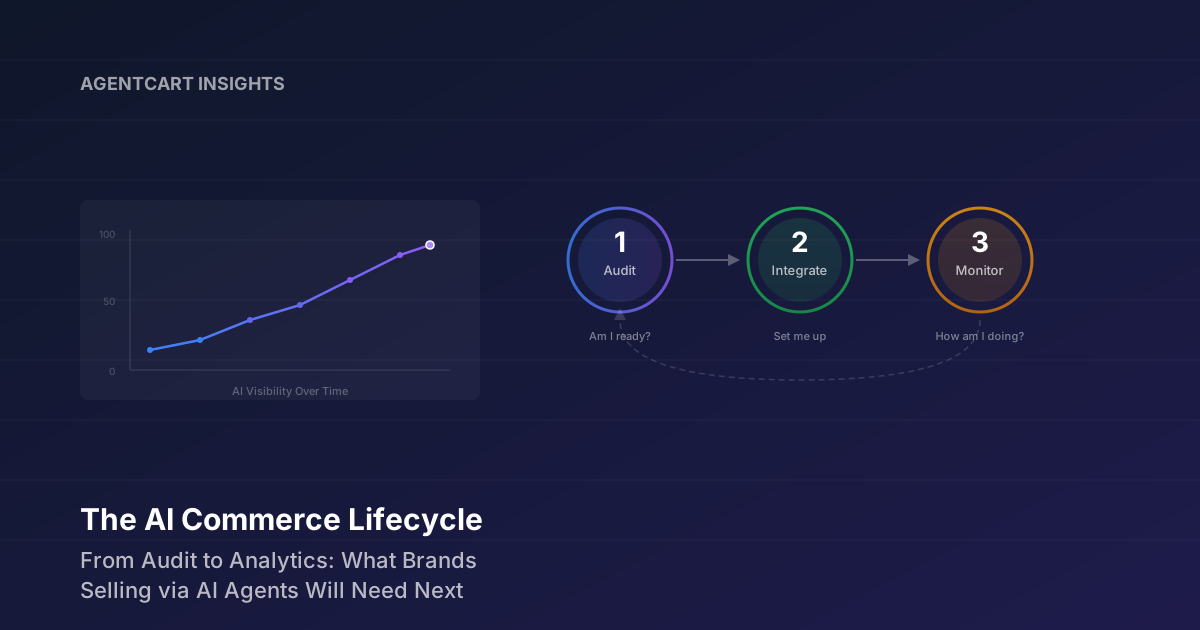
The Three Phases of AI Commerce
Based on what we’re seeing across brands of all sizes, the AI commerce journey follows three distinct phases:
Phase 1: Audit — “Am I ready?”
This is where most merchants are today. They’ve heard that AI agents are starting to facilitate shopping — ChatGPT launched shopping features, Google is integrating commerce into Gemini, Perplexity has a buy button — and they want to know where they stand.
The audit phase covers four dimensions:
- Schema.org Markup — Do AI crawlers have structured product data to work with? Prices, availability, reviews, images?
- ACP (Agent Commerce Protocol) — Can AI shopping agents like ChatGPT build a feed from your product data?
- Agent Accessibility — Are AI crawlers (ChatGPT-User, Google-Extended, PerplexityBot) even allowed to access your site?
- UCP (Universal Commerce Protocol) — Does your store declare its commerce capabilities in a machine-readable format?
When we audited Shopify’s 50 Best Stores, the average readiness score was 70/100 — but that number masked a huge gap. Agent Accessibility averaged 91 (easy win), while UCP averaged 23 (nobody’s implemented it yet). Schema and ACP sat in the middle, with most stores getting a partial score from Shopify’s built-in structured data.
The audit phase is about awareness. Most brands don’t even know these protocols exist, let alone that AI models are using them (or trying to) right now.
Phase 2: Integration — “Set me up”
Once a brand knows their gaps, they need to fix them. This is the implementation phase:
- Adding comprehensive Schema.org Product markup across all product pages
- Configuring product feeds that AI shopping agents can consume
- Implementing the Universal Commerce Protocol manifest
- Setting up Agentic Checkout APIs for direct AI-to-store transactions
- Ensuring robots.txt allows AI crawlers
- Getting certified with platforms like OpenAI for verified merchant status
Companies like ACP Feed are emerging specifically to handle integration for the Agent Commerce Protocol. Shopify is building native support. Platform-level solutions will eventually make this easier, but right now it’s largely manual.
The integration phase has a clear end state: your store is connected, feeds are flowing, protocols are implemented. Check the boxes and move on.
Phase 3: Monitor & Optimize — “How am I doing?”
This is the phase nobody is building for yet — and it’s the one that matters most long-term.
Once you’re live on AI commerce platforms, you enter an ongoing operational reality that looks nothing like traditional ecommerce. There’s no dashboard showing your AI traffic. No analytics for how often AI agents recommend you. No way to A/B test how your product descriptions perform in AI-generated responses.
Think about the tools that exist for traditional ecommerce:
| Traditional Ecommerce | AI Commerce Equivalent |
|---|---|
| Google Analytics | Doesn’t exist |
| Google Search Console | Doesn’t exist |
| SEO monitoring (Ahrefs, SEMrush) | Doesn’t exist |
| Price monitoring tools | Doesn’t exist |
| Brand monitoring / reputation | Doesn’t exist |
| Conversion rate optimization | Doesn’t exist |
This table is the opportunity. Every row represents a category of tooling that will need to be built for the AI commerce era.
What Brands Will Need in Phase 3
Based on the patterns we’re seeing from brands that are already AI-commerce-ready, here are the specific capabilities they’re going to need:
1. AI Visibility Analytics
The most urgent gap. When a consumer asks ChatGPT “What’s the best wireless charger under $50?”, does your brand appear in the response? How often? On which AI platforms? For which queries?
Today, brands have zero visibility into this. There’s no equivalent of “impression count” or “search ranking” for AI commerce. You can’t see:
- How many AI queries triggered a mention of your brand
- Whether ChatGPT recommends you more than Gemini (or vice versa)
- Which product categories you’re winning vs. losing
- How your mention rate is trending over time
This is the “Google Search Console” of AI commerce — the foundational analytics layer that every merchant selling through AI will need.
2. Competitive Intelligence
In traditional SEO, you can see exactly where competitors rank for your target keywords. In AI commerce, you’re blind. Brands will need tools that answer:
- “When someone asks ChatGPT for products in my category, who gets recommended instead of me?”
- “My competitor just improved their Schema markup — did their AI visibility change?”
- “Which brands are gaining AI share in my category this month?”
3. AI Brand Accuracy Monitoring
AI models hallucinate. They get prices wrong. They confuse product lines. They attribute features from one brand to another. As AI-assisted shopping scales, brands will need monitoring for:
- Price accuracy — Is the AI showing the right price, or yesterday’s?
- Product accuracy — Are product features and descriptions correct?
- Brand safety — Is the AI associating your brand with incorrect claims?
- Availability sync — Is the AI recommending products that are actually in stock?
One wrong price in a ChatGPT shopping response can mean a lost sale or a customer service headache. Multiply that by millions of AI queries and it becomes a brand integrity issue.
4. Multi-Agent Performance Comparison
Not all AI agents are equal. A brand might get 40% mention rate on ChatGPT but only 5% on Perplexity. Understanding why requires comparing performance across agents:
- ChatGPT weighs structured product data and ACP feed quality
- Gemini leverages Google’s index and UCP protocol
- Perplexity prioritizes sourced, factual content with citations
- Copilot blends Bing’s index with conversational commerce
Each agent has different signals, different data sources, and different recommendation logic. Brands will need per-agent analytics to know where to invest optimization effort.
5. Feed & Data Optimization
Traditional ecommerce has extensive tooling for optimizing product listings — from keyword research to A/B testing titles to image optimization. The AI commerce equivalent doesn’t exist yet but will include:
- Product description optimization for AI consumption — What makes an AI model more likely to recommend your product?
- Schema markup scoring — How complete is your structured data compared to competitors?
- Feed health monitoring — Are your ACP and UCP feeds syncing correctly? Any data quality issues?
- Attribute gap analysis — What product data are AI models looking for that you’re not providing?
The Emerging Market Map
Looking at the landscape, a clear market map is forming:
| Phase | Need | Who’s Building |
|---|---|---|
| 1. Audit | Readiness scoring & gap analysis | AgentCart, manual audits |
| 2. Integrate | ACP implementation | ACP Feed, Shopify (native), agencies |
| 2. Integrate | UCP implementation | Almost nobody yet |
| 2. Integrate | Schema optimization | Yoast, schema plugins (partial) |
| 3. Monitor | AI visibility analytics | Nobody (yet) |
| 3. Monitor | AI brand monitoring | Nobody (yet) |
| 3. Monitor | Competitive intelligence | Nobody (yet) |
| 3. Monitor | Feed optimization | Nobody (yet) |
Phase 1 and 2 are starting to get coverage. Phase 3 is wide open. And Phase 3 is where the recurring, long-term value lives — just like SEO monitoring became a bigger business than one-time SEO audits.
Why This Matters Now
You might think this is premature. AI shopping is still early. Most consumers still Google things and click links. But consider the trajectory:
- ChatGPT processes hundreds of millions of conversations daily. Shopping is now a native feature, not a plugin.
- Google is integrating AI directly into search results and shopping experiences. AI Overviews already appear for product queries.
- Perplexity has a buy button. Users can purchase without leaving the AI interface.
- OpenAI and Stripe co-developed the Agentic Commerce Protocol — an open standard specifically designed for AI agents to transact on behalf of users.
The infrastructure for AI commerce is being built right now. The brands that understand the full lifecycle — not just the audit, but the ongoing analytics and optimization — will have a structural advantage as this channel scales.
What To Do Today
Regardless of where you are in the lifecycle, here’s what to prioritize:
- Know your baseline. Run an audit. Understand your scores across Schema, ACP, Agent Accessibility, and UCP. You can’t optimize what you don’t measure. Get a free scan here.
- Fix the high-impact gaps first. Schema markup and agent accessibility are table stakes. If AI crawlers can’t access your site or parse your products, nothing else matters.
- Start tracking AI visibility. Even manually — search for your brand and category on ChatGPT, Gemini, and Perplexity. Note what comes up. This builds intuition for how AI models see your brand.
- Watch the protocol landscape. ACP and UCP are evolving fast. Being an early adopter of these standards is a competitive moat while your competitors are still figuring out what they are.
- Think beyond the setup. Integration is a one-time project. The real value is in ongoing monitoring and optimization. Start building the muscle now.
The Bottom Line
AI commerce is following the same pattern as every previous ecommerce channel: first comes the infrastructure (protocols, integrations), then comes the analytics and optimization layer. We’re at the inflection point between the two.
The brands that treat AI commerce as a “set it and forget it” integration project will fall behind. The ones that build ongoing visibility monitoring and optimization into their operations will win the AI shopping era — just like the brands that invested in SEO early won the Google era.
Phase 3 is coming. The question is whether you’ll be ready for it.
Check your AI commerce readiness
Get your free score across Google UCP, ChatGPT Shopping, and Schema.org in under 30 seconds.
Run a free scan