Cloudflare Now Serves Markdown to AI Agents. Here’s What It Means for Your Store.
Cloudflare’s new Markdown for Agents feature converts HTML to clean markdown when AI crawlers request your pages — cutting token usage by 80%. It’s the clearest signal yet that AI agent traffic is becoming a first-class concern for every website.
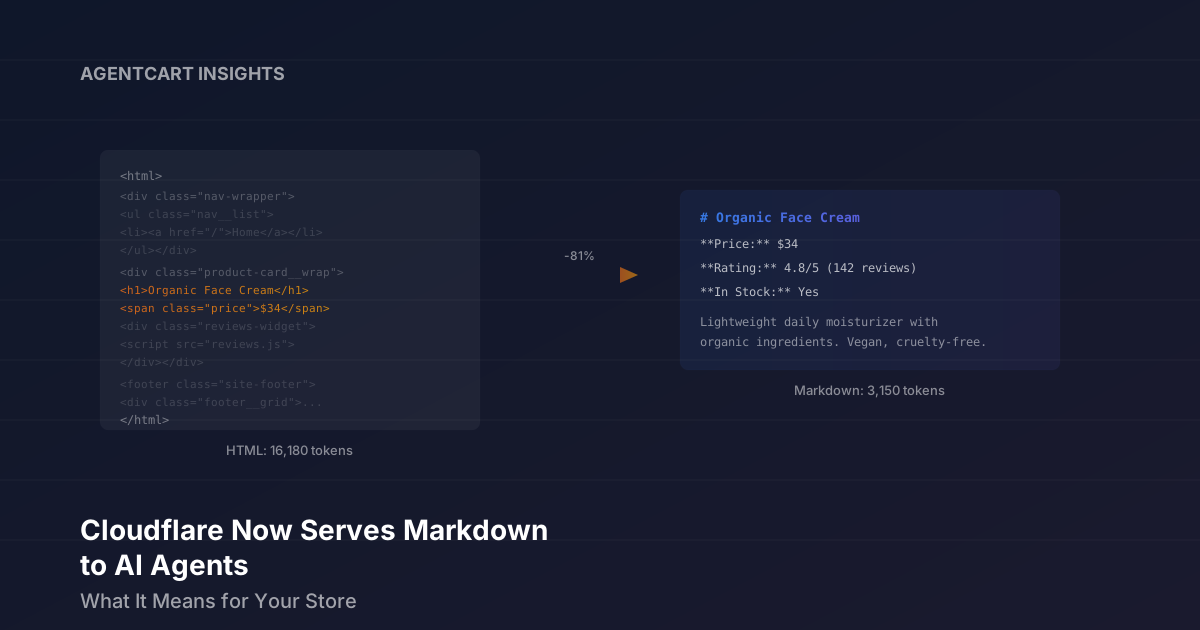
On February 12, Cloudflare launched Markdown for Agents — a feature that automatically converts your HTML pages to clean markdown whenever an AI crawler or agent requests them. It’s free, it’s a single toggle in the dashboard, and it cuts the token count of a typical web page by 80%.
That last number is the one that matters. Cloudflare’s own blog post is 16,180 tokens in HTML. In markdown? 3,150 tokens. Same content, 81% less noise for the AI to process.
This isn’t a niche developer tool. It’s Cloudflare — the CDN behind roughly 20% of the web — acknowledging that AI agents are now a meaningful traffic source worth optimizing for. And that has implications for every brand selling online.
How It Works
The mechanism is straightforward: HTTP content negotiation. When an AI crawler sends a request with Accept: text/markdown in the header, Cloudflare intercepts the response from your server, converts the HTML to markdown, and serves the clean version to the agent.
Your human visitors see nothing different. Your origin server doesn’t change. The conversion happens at Cloudflare’s edge, at the network level.
AI systems that already send markdown acceptance headers include OpenAI’s OAI-SearchBot (the crawler behind ChatGPT Shopping) and Anthropic’s Claude. When the feature is enabled, these crawlers get markdown instead of HTML automatically.
Each response also includes an x-markdown-tokens header with the estimated token count — useful for AI systems managing context windows.
Why This Matters for Ecommerce
If you’re a brand selling products online, here’s why you should care:
1. AI agents are parsing your pages right now
When someone asks ChatGPT “What’s the best organic face moisturizer under $40?”, the AI model doesn’t browse your website like a human. It processes the raw content of your pages — and right now, that content is full of HTML noise: navigation bars, footer links, script tags, CSS classes, ad containers. The actual product information is buried in the markup.
Markdown strips all of that away. What’s left is the content itself: product names, descriptions, prices, reviews. The signal without the noise.
2. Cleaner input = better comprehension
AI models have limited context windows. Every token spent parsing <div class="product-card__wrapper--v2"> is a token not spent understanding your product description. When the same page is served as markdown, the AI can devote its full attention to the content that actually matters.
This means: better understanding of what you sell, more accurate product information in AI responses, and a higher chance of being recommended.
3. It validates the AI commerce infrastructure layer
Cloudflare building this feature is a signal. CDN providers don’t invest engineering resources in niche use cases. They build for traffic patterns that are real and growing. The fact that Cloudflare is optimizing the delivery layer for AI agents means AI agent traffic has crossed the threshold from “interesting experiment” to “infrastructure-grade concern.”
The Controversy
Not everyone is enthusiastic. Google’s John Mueller called the concept “a stupid idea,” questioning why platforms wouldn’t just parse standard HTML. Microsoft’s Fabrice Canel warned that non-user versions of pages are “often neglected, broken.”
The core concern is cloaking — serving different content to bots than to humans. In traditional SEO, this is a violation of search engine guidelines. If your HTML page says one thing and the markdown version says another, you’ve created what one SEO consultant called “a shadow web for bots.”
It’s a valid concern. But Cloudflare’s implementation is different from manual cloaking in a key way: the markdown is derived directly from the HTML, not authored separately. The conversion is automated and deterministic. Same content, different format.
That said, there’s a subtlety worth noting: the converted responses include a Content-Signal header set to ai-train=yes, search=yes, ai-input=yes by default. This explicitly signals that the content can be used for AI training and search. Publishers who are selective about AI usage rights should review this setting carefully.
What This Means for AI Commerce Readiness
We’ve been auditing stores for AI commerce readiness across four dimensions: Schema Markup, Agent Accessibility, ACP (AI Shopping Data), and UCP (Universal Commerce Protocol). Cloudflare’s Markdown for Agents touches on all of them:
| Dimension | How Markdown for Agents Helps |
|---|---|
| Schema Markup | Cleaner page content makes structured data easier for AI to extract, even when schema markup is incomplete |
| Agent Accessibility | Serving optimized content to AI crawlers is the next step beyond simply not blocking them |
| ACP (Shopping Data) | Product information is more parseable in markdown, improving compatibility with AI shopping protocols |
| UCP Compliance | Doesn’t directly affect UCP (which is a separate manifest), but a markdown-optimized page alongside a UCP manifest is the full picture |
Think of it this way: Schema markup tells AI agents what your products are. Agent accessibility determines whether they can reach your site. Markdown for Agents determines how clearly they can read it once they get there.
The Bigger Picture
Cloudflare’s move fits into a broader trend we’ve been tracking. The infrastructure for AI commerce is being built in layers:
- Access layer — AI crawlers can reach your site (robots.txt, agent accessibility)
- Data layer — Your product data is structured and machine-readable (Schema.org, ACP feeds)
- Protocol layer — Your store declares its commerce capabilities (UCP, ACP checkout)
- Delivery layer — Your content is optimized for AI consumption (this is what Cloudflare just built)
Most brands are still working on layers 1–3. Layer 4 is new. But it won’t stay new for long — if Cloudflare is building it into their CDN, it’s about to become table stakes.
What To Do
If your site is on Cloudflare (Pro, Business, or Enterprise plan):
- Enable Markdown for Agents in your Cloudflare dashboard under Quick Actions. It’s a single toggle, free, and zero risk to your existing site.
- Review the Content-Signal defaults. The feature sets
ai-train=yesby default. If you have concerns about AI training usage, adjust this setting. - Don’t treat this as a replacement for structured data. Markdown improves how AI reads your content, but Schema.org markup, ACP feeds, and UCP manifests are still the foundation. Markdown is the delivery optimization, not the data itself.
If your site is not on Cloudflare, this is still a signal worth paying attention to. Other CDN and platform providers will likely follow. The direction is clear: optimizing for AI agent consumption is becoming part of standard web infrastructure.
Either way, the first step is understanding where you stand. Run a free AI readiness scan to see how AI agents currently see your store — and what to fix first.
Check your AI commerce readiness
Get your free score across Google UCP, ChatGPT Shopping, and Schema.org in under 30 seconds.
Run a free scan