AI Mention Rate Ranking: Which Shopify Stores Do AI Agents Actually Recommend?
We benchmarked all 50 stores on Shopify’s “Best of 2026” list across ChatGPT, Gemini, and Perplexity. One brand hit 75% visibility. Eleven were completely invisible. Here’s the full ranking.
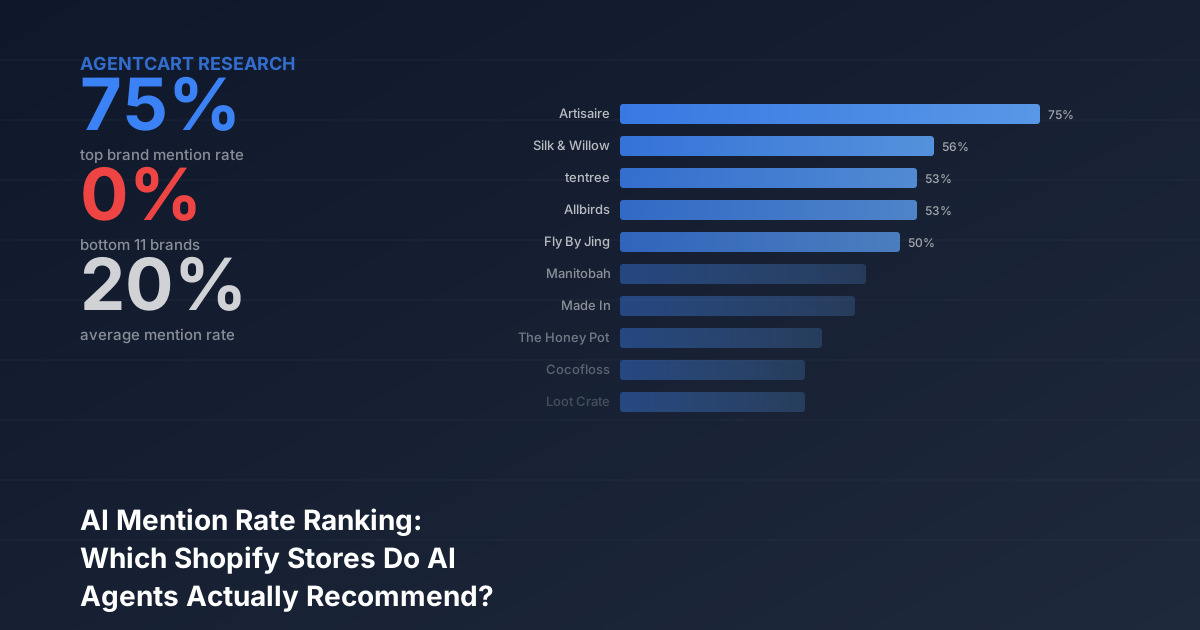
When a shopper asks ChatGPT “What’s the best sustainable sneaker brand?” or tells Gemini “Find me an artisan chocolate gift,” does your brand come up?
For most Shopify stores — even ones on Shopify’s own “Best of 2026” list — the answer is no.
We ran AI visibility simulations across ChatGPT, Google Gemini, and Perplexity for all 50 stores in our recent Shopify 50 audit. For each brand, we generated category-relevant shopping queries and measured how often each AI model mentioned the brand in its response.
The results are stark. Here’s the full ranking.
The Full AI Mention Rate Ranking
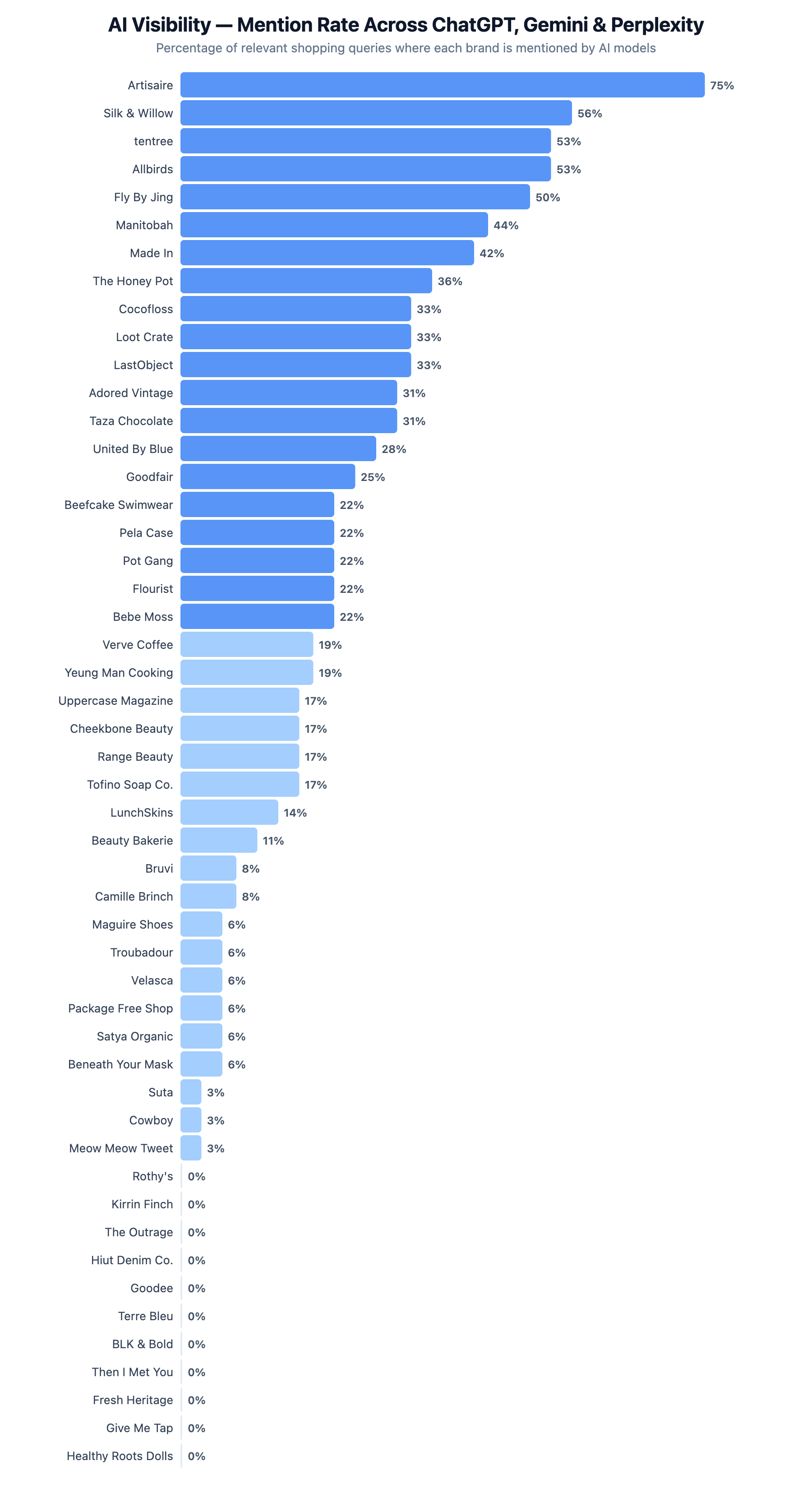
The chart shows the mention rate — the percentage of relevant shopping queries where each brand was named by at least one AI model. We tested across ChatGPT, Gemini, and Perplexity with queries tailored to each brand’s product category and competitive landscape.
The Top 5: What They Have in Common
| Rank | Brand | Mention Rate | Why AI Knows Them |
|---|---|---|---|
| 1 | 75% | Category creator — dominates “wax seal” niche | |
| 2 | 56% | Press-heavy brand in luxury wedding niche | |
| 3 | 53% | Mission-driven story (plant 10 trees per item) | |
| 4 | 53% | Category-defining “sustainable sneaker” brand | |
| 5 | 50% | Media darling — Sichuan sauce category leader |
The pattern is clear: AI models recommend brands they can explain in one sentence.
Artisaire doesn’t just sell wax seals — it is the wax seal brand. When someone asks an AI for wax seals or stationery gifts, Artisaire is the obvious answer because the brand has been written about extensively and owns its niche.
The same applies to every top performer. Allbirds = sustainable wool sneakers. tentree = plant trees with every purchase. Fly By Jing = premium Sichuan chili crisp. These aren’t just taglines — they’re the actual associations baked into AI training data from years of press, reviews, and social content.
The Middle: Visible but Inconsistent (17–44%)
Brands in the 17–44% range are known but not dominant. They get mentioned for some queries but not others, and they’re often competing with better-known alternatives.
Manitobah (44%) benefits from its Indigenous heritage and distinctive mukluks — a unique enough product that AI models mention it for winter footwear queries.
Made In (42%) has strong coverage in the premium cookware space, though it competes with established names like All-Clad and Le Creuset.
In this tier, AI visibility is fragile. A brand might appear for “best sustainable swimwear” but not “best swimwear for summer.” The more generic the query, the more these mid-tier brands get crowded out.
The Bottom 11: Completely Invisible
Eleven brands scored 0% — not mentioned in a single relevant AI query across any model:
Rothy’s
Kirrin Finch
The Outrage
Hiut Denim Co.
Goodee
Terre Bleu
BLK & Bold
Then I Met You
Fresh Heritage
Give Me Tap
Healthy Roots Dolls
Some of these are genuinely surprising. Rothy’s is a well-known sustainable shoe brand with significant press coverage.
BLK & Bold is a nationally distributed coffee brand available at Target and Whole Foods. Yet neither appeared in our AI simulations.
The takeaway: brand awareness among humans doesn’t automatically translate to AI visibility. AI models surface brands based on their training data, and that data skews toward brands with strong online content, reviews, and editorial coverage in the right contexts.
The Readiness Paradox
One of the most counterintuitive findings from our full audit: technical readiness and AI visibility are poorly correlated.
| Brand | Readiness Score | Mention Rate |
|---|---|---|
| 86 (#1 overall) | 14% | |
| 85 (top 5) | 3% | |
| 40 (bottom 10) | 53% | |
| 42 (bottom 10) | 33% |
LunchSkins has the highest readiness score of any Shopify 50 store — excellent schema markup, clean AI crawler access, solid product data — yet gets mentioned in only 14% of relevant queries.
Cowboy, the electric bike brand, scores 85 on readiness but just 3% on visibility.
Meanwhile, tentree scores poorly on technical readiness (40/100) but gets mentioned in over half of relevant queries. The brand’s story — plant 10 trees with every purchase — has generated enough press and online discussion that AI models know about it regardless of technical setup.
This tells us something important: AI visibility today is driven primarily by brand narrative and training data, not technical infrastructure. But that won’t last. As AI shopping moves from recommendation to transaction — think ChatGPT Instant Checkout and Google UCP — technical readiness becomes the gatekeeper. A brand that’s mentioned but can’t transact loses the sale to one that can.
What Drives AI Mention Rate?
Looking across all 50 brands, several factors correlate with higher mention rates:
1. Niche Ownership
Brands that own a specific product category outperform generalists. Artisaire (wax seals), Fly By Jing (Sichuan chili), and LastObject (reusable personal care) all rank high because when someone asks about their category, they’re the obvious answer.
2. Mission-Driven Narrative
AI models love a clear story. tentree (plant trees), Allbirds (sustainable materials), United By Blue (ocean cleanup) — these brands give AI a reason to recommend them beyond just “they sell good products.”
3. Press and Editorial Coverage
Brands with extensive coverage in publications that AI models were trained on get mentioned more. This is essentially the AI equivalent of traditional brand authority — if journalists wrote about you, AI knows about you.
4. Review Density
Brands with lots of customer reviews across platforms (not just their own site) tend to appear more in AI responses. Reviews create the kind of comparative, opinion-rich content that AI draws from when making recommendations.
The Three Tiers of AI Visibility
Based on this data, we see three distinct tiers:
| Tier | Mention Rate | Brands | What It Means |
|---|---|---|---|
| AI-Visible | 33%+ | 13 of 50 | AI models actively recommend these brands. They appear in multiple query types across multiple models. |
| AI-Adjacent | 3–28% | 26 of 50 | Occasionally mentioned, but not consistently. Visible for niche queries, invisible for broader ones. |
| AI-Invisible | 0% | 11 of 50 | Never mentioned. AI models don’t surface them in any tested shopping context. |
Only 26% of Shopify’s “best” stores are consistently visible to AI shopping agents. The majority are either invisible or barely present.
What You Should Do About It
If your brand is in the bottom two tiers, the path forward has two parts:
Short-Term: Build the Narrative
AI models recommend brands they can explain. Ask yourself: can an AI summarize why someone should buy from you in one sentence? If not, you have a positioning problem, not a technical one. Invest in PR, get featured in roundups and reviews, and create the kind of content that makes your brand the obvious answer for your category.
Long-Term: Build the Infrastructure
As AI shopping evolves from recommendations to transactions, technical readiness will matter more. Implement comprehensive Schema.org markup, ensure your UCP manifest is in place, and optimize your product data for AI consumption. The brands that combine high visibility with high readiness will capture the most value.
Methodology
All 50 stores from Shopify’s “50 Best Shopify Stores to Inspire Your Own (2026)” were benchmarked using AgentCart in February 2026. For each brand, we generated category-specific shopping queries based on the brand’s product catalog and competitive landscape, then ran simulations across ChatGPT, Google Gemini, and Perplexity. Mention rate = percentage of relevant queries where the brand was named in at least one AI response.
Check your AI commerce readiness
Get your free score across Google UCP, ChatGPT Shopping, and Schema.org in under 30 seconds.
Run a free scan