Mastercard Agent Pay Is Live. Here’s What It Means for Checkout in the AI Era.
The agentic commerce stack had a missing layer: trusted payments. Mastercard’s Agent Pay — now integrated with Google UCP, Microsoft Copilot, and PayPal — fills it. Here’s how it works and what merchants need to know.
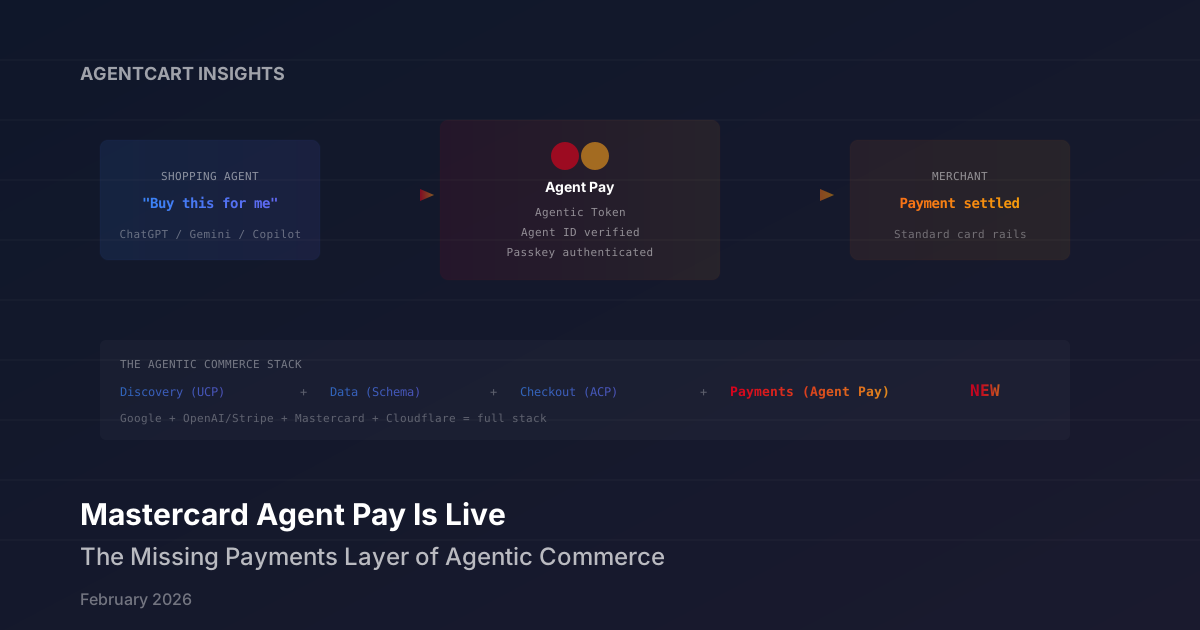
Over the past few months, the infrastructure for AI-powered shopping has assembled itself piece by piece. Google shipped the Universal Commerce Protocol. OpenAI and Stripe launched the Agentic Commerce Protocol. Cloudflare started serving markdown to AI crawlers. Schema.org became the de facto product data layer.
But there was a gap. All of these protocols solved discovery, data, and checkout — the front half of the transaction. None of them solved the hard part: how does an AI agent actually pay for something on your behalf, securely, without exposing your card number?
Mastercard just answered that question. Agent Pay is live, integrated with major platforms, and processing real transactions. It’s the missing payments layer of the agentic commerce stack.
What Agent Pay Actually Is
Agent Pay is Mastercard’s framework for letting AI agents make authenticated payments on behalf of consumers. It was unveiled in April 2025, went live in Latin America in December 2025, and has since expanded globally — including Australia’s first authenticated agentic transactions in early 2026.
The core idea: when an AI shopping agent needs to complete a purchase for you, it doesn’t get your credit card number. Instead, it uses an agentic token — a dynamic, cryptographically secure credential that’s tied to a specific agent, a specific user, and a specific set of permissions.
Think of it as the same tokenization technology that makes Apple Pay and Google Pay work, extended to AI agents. Your card number never touches the agent. What travels through the payment flow is a token that can only be used within the boundaries you’ve defined.
The Three Pillars
Mastercard built Agent Pay on three principles that address the unique risks of letting software act on your behalf:
1. Intent
Every agentic transaction must trace back to an explicit consumer intent. The system uses payment passkeys and two-factor authentication to confirm that the cardholder actually consented to the purchase. No agent can buy something you didn’t ask for.
Mastercard is also working with the FIDO Payments Working Group on a Verifiable Credential standard that confirms key transaction details — amount, merchant, product — creating a cryptographic proof of what the consumer actually approved.
2. Tokenization
Agentic tokens build on Mastercard’s existing Secure Card on File technology. Each token is dynamic (not reusable across contexts), cryptographically secure, and scoped to the permissions the consumer has defined. The agent submits a Dynamic Token Verification Code — formatted for standard card payment fields — so merchants don’t need custom integration logic.
3. Agent Identification
Before an AI agent can transact on the Mastercard network, it must be registered and verified through the Agent Pay Acceptance Framework. Every participant in the payment flow — issuer, acquirer, and merchant — can see that an agent conducted the transaction, which agent it was, and on whose behalf it acted.
This is the part that matters most for trust. When a suspicious transaction hits your fraud system, you can distinguish “legitimate AI agent acting on behalf of a verified cardholder” from “unknown automated purchase.”
Who’s Already Integrating
Agent Pay isn’t theoretical. It’s being built into the platforms where AI shopping is actually happening:
| Platform | Integration | Status |
|---|---|---|
| Google UCP | Agent Pay powers checkout in AI Mode via Search and Gemini. Mastercard joined Google’s coalition alongside Adyen, Amex, Stripe, and Visa. | Live (US) |
| Microsoft Copilot | Agent Pay is being integrated into Copilot Checkout for agentic purchases through Microsoft’s assistant. | In progress |
| PayPal | Agent Pay will be embedded in PayPal’s wallet, allowing AI agents to complete transactions for PayPal users. | Announced Oct 2025 |
| Fiserv | Agent Pay Acceptance Framework is being added to Fiserv’s merchant systems, including Clover POS and eCommerce platforms. | In progress |
The Fiserv integration is particularly notable for merchants. Fiserv processes payments for millions of businesses. Once Agent Pay is embedded in Clover and Fiserv’s ecommerce infrastructure, merchants can accept agent-driven transactions without building any custom logic. The AI-initiated purchase flows through the same authorization, settlement, and reconciliation rails they already use.
Fiserv is also simultaneously integrating Visa’s Trusted Agent Protocol, positioning itself as a multi-network enabler. For merchants, this means one integration could support agentic payments across both Mastercard and Visa.
Agent Suite: The Merchant Toolkit
Beyond Agent Pay itself, Mastercard is launching Agent Suite in Q2 2026 — a service that helps merchants deploy their own AI agents. It combines customizable AI agents with consulting from Mastercard’s 4,000+ advisory team, access to Mastercard’s payments infrastructure, and proprietary data assets.
Two use cases stand out:
- Conversational shopping agents that merchants can configure with rules for inventory, margins, promotions, and brand voice — essentially giving every merchant an AI shopping assistant on their own storefront
- Product discovery agents for financial institutions that recommend cards, accounts, and services based on customer needs
As Mastercard’s head of insights put it: “Readiness is the new competitive advantage. Those who lay the groundwork can embrace new commercial opportunities much faster.”
The Complete Agentic Commerce Stack
With Agent Pay live, every layer of the agentic commerce stack now has real infrastructure behind it:
| Layer | What It Solves | Who Built It |
|---|---|---|
| Discovery | How AI agents find and understand your products | Google UCP, Schema.org |
| Data | Structured product information AI can consume | Schema.org, ACP feeds |
| Delivery | Optimized content format for AI consumption | Cloudflare Markdown for Agents |
| Checkout | Protocols for AI agents to initiate purchases | OpenAI/Stripe ACP, Google UCP |
| Payments | Secure, authenticated agent-to-merchant payments | Mastercard Agent Pay, Visa TAP |
| Trust | Agent identity, fraud detection, consumer consent | Mastercard Agentic Tokens, FIDO |
Six months ago, half this table didn’t exist. Now every layer has at least one production-grade solution. The stack is complete.
What This Means for Merchants
If you’re selling products online, here’s the practical reality:
The good news: you probably don’t need to do anything for Agent Pay specifically
Agent Pay is designed to work through existing payment rails. When Fiserv, Adyen, or your payment processor integrates the Agent Pay Acceptance Framework, your store can accept agentic transactions through the same card infrastructure you already have. No new APIs. No custom checkout flows.
The real work is everything upstream
Agent Pay solves the last step. But an AI agent can’t pay for a product it never discovered. The work for merchants is still in the layers above:
- Can AI agents find you? Do you have comprehensive Schema.org markup? Is your product data structured and complete?
- Can AI agents access you? Are crawlers like ChatGPT-User, Google-Extended, and PerplexityBot allowed in your robots.txt?
- Can AI agents sell you? Have you implemented UCP or registered for ACP? Can an agent actually initiate a checkout?
When we audited Shopify’s 50 Best Stores, the average readiness score was 70/100 — but UCP adoption was 0 out of 50. Most stores have decent product data and agent access, but almost none have implemented the commerce protocols that let agents transact. Agent Pay makes the payment layer ready. The question is whether your store is ready for everything that comes before it.
The competitive window is closing
Google’s UCP coalition already includes Shopify, Target, Walmart, Wayfair, and Etsy. OpenAI’s ACP is live in ChatGPT. Mastercard’s Agent Suite launches in Q2. By mid-2026, the infrastructure will be mature enough that AI agents can discover, recommend, and purchase products end-to-end for consumers who never visit a website.
Brands that are ready will capture that demand. Brands that aren’t will be invisible to it.
The Bigger Picture
What’s remarkable about the past eight weeks is the speed of convergence. Google, OpenAI, Mastercard, Visa, PayPal, Cloudflare, Fiserv — these aren’t startups experimenting. They’re the largest infrastructure companies in payments and technology, all building for the same future at the same time.
Pablo Fourez, Mastercard’s Chief Digital Officer, summarized it well: “Open, interoperable protocols are the spark for agentic commerce.”
The spark has been lit. The stack is built. The question for every merchant is no longer “Is this real?” but “Am I ready?”
Run a free AI readiness scan to see where your store stands across all six layers of the agentic commerce stack.
Check your AI commerce readiness
Get your free score across Google UCP, ChatGPT Shopping, and Schema.org in under 30 seconds.
Run a free scan